The invisible illness
For as long as humans have existed, they have lived by the notion ‘if I can’t see it, then it’s not real’. This has been applied to the unknown varying from; aliens, ghosts, spiritual beings etc. It has also been used to refer to mental illness, as often you aren’t able to identify any visible symptoms, abnormalities in brain function or chemical imbalances. People assume that the illness does not exist. In comparison, any physical illness can be explained by evidence found in objective testing such as; blood test, EEG/ECG, MRI, CAT scan, blood pressure monitor, blood sugar monitor etc. These are all signs that can be equated and explain a physical illness. But something which is not visible to many means that it does not exist and is made up.
Most of societies believe mental illness is ‘made up’, the person is ‘exaggerating or a drama queen’, and it’s ‘all in their head’. But this is a misconception and misjudgement of an illness. What we can’t see doesn’t mean it doesn’t exist. Just because you don’t understand something, doesn’t mean you write it off. Most mental illnesses are subjective in nature, only the individual is bale to express the symptoms of the illness, these can vary from; hearing voices, hallucinations or emotion (sadness, anger, mania etc.). These symptoms may not be easily identifiable to others and have to be expressed by the individual.

So the question is how do we know these symptoms are real?
There are many tell-tale signs which can prove these subjective symptoms are symptoms of a mental illness.
For example, hearing voices, this is something which can’t be proven or disproven. The individual will often appear distracted, appears to be listening to unseen stimuli and responding verbally and non-verbally to the unseen stimuli. In addition, they may become manic, angry or distressed spontaneously, often the result of the voices. Their actions may be impulsive and sporadic in nature. They may not make eye contact, illogical thought processes and pressured speech. This is not an exhaustive list, but a brief over view of some common signs.
If properly observed and assessed, than this shows the individual hears voices. However, the assessment is individualistic to the person conducting the assessment, but does not make it any less valid.
Unlike physical illnesses which use scientific tools that measure in real time the illness and computes evidence that cannot be refuted. Mental illnesses are based upon psychometric testing, diagnostic guides and subjective assessments of the individual. So both physical and mental illness use differing diagnostic methods, but both are scientifically proven by research and valid in nature.
Many individuals, whom believe in the bio-medical model to health, don’t view the study and assessment of mental illness scientific. Therefore, they are more likely to dismiss symptoms or miss- interprets them, based on their perception. This can lead to patients being untreated or mis-diagnosed. This practice is becoming uncommon, in today’s society but can occur.
Individuals studying medicine, GPs and other healthcare professionals, are now being trained in mental illness and psychology, so they are able to spot signs early and assess more effectively. This shows a positive step forward, as the medical model is being challenged and used in conjunction with psychological models for assessment.
Let’s not be mistaken, physical illness can lead to mental illness, and vice versa. This is very common and so the two are being treated together. I have experience in working in health psychology, which combines both physical and mental health. I used to work in oncology and engage in patients whom were at varying stages of their oncology journey, and suffered from some psychological distress due to the illness and/or treatment. Their mental states often would steer their oncology treatment and vice versa. Patients may become depressed and have fleeting thoughts to self-harm, so would stop their current treatment or delay it. Others may have increased anxiety surrounding treatment and would look to homeopathy medications such as cannabis oil, to avoid having more treatment. Working in health psychology gave me great insight into how psychology and the medical community were integrating in their approach to care.
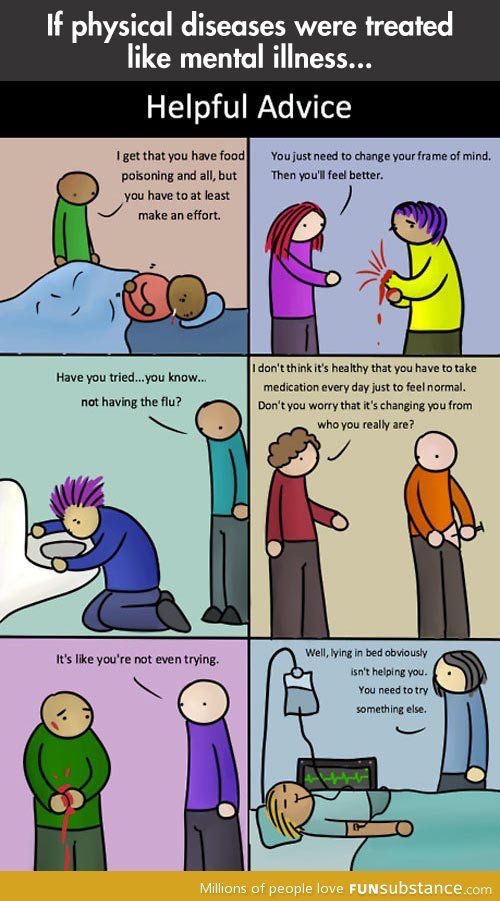
The perception of illness varies greatly from person to person. One individual may be very empathic and caring, whereas another may engage in tough love. This variation is based on our perceptions and experiences in life. Very little can completely change our perception, as we always find a natural way to revert back to it. In terms of physical health our perception is very accepting, a sense of urgency, in terms of receiving treatment and ensuring the care needed is received. This also translates to mental health, but there is a difference.
For example, if there is an individual lying on the floor, screaming and shouting they are in pain and unable to move, holding their leg. Without any judgment, question or delay we ensure they are ok and call the paramedics as we can see they are hurt. This is a very common and natural response.
Now lets take the same scenario as above, with the individual on the floor, in apparent pain and unable to move, but you have knowledge they suffer with a mental illness. Does your response change? Interestingly, many will have the same response as depicted above. But there are a group of people, whom will delay calling the paramedics, they will assess, question, judge and doubt the validity of the pain. Questions will be raised and their mental health history will be looked into, so see if they have exhibited this behaviour before. Then a judgment will be made whether to send them to A&E or not. But is this delay in care reasonable?
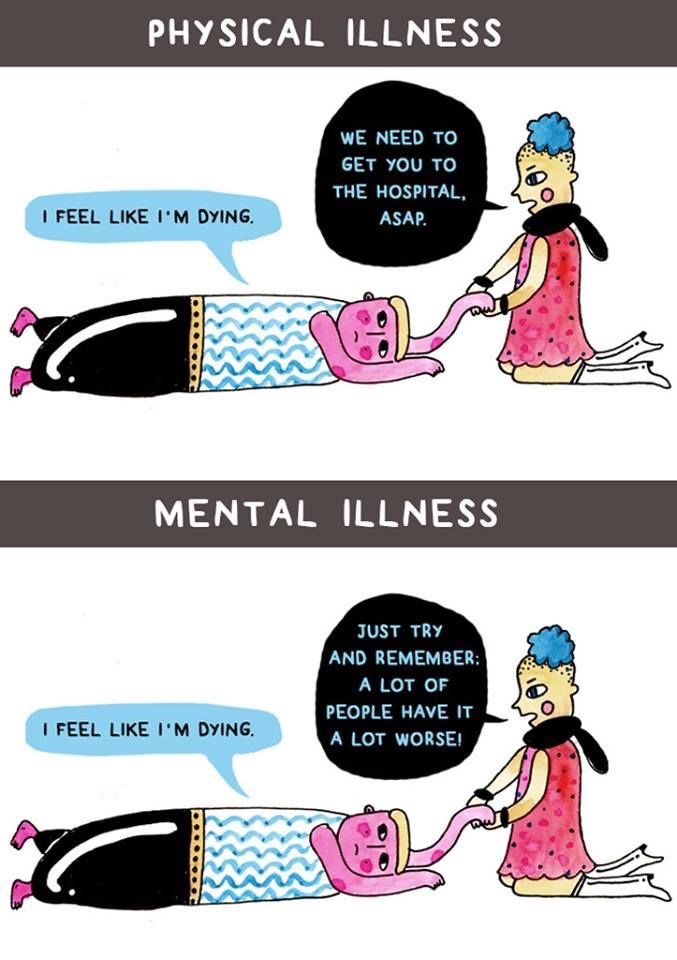
Sit back and compare both situations. They are the same situation with only one difference between them But as you can see, one added piece of information can change your perception.
This is not an uncommon occurrence. Having the knowledge that an individual has a mental illness, throws doubt into a person’s mind. To the extent their care and treatment is under question. So why do we this?
On one side, the questioning and doubt can be justified as you want to ensure they aren’t wasting NHS resources or don’t want to re-enforce the behaviour. On the other hand though, its not so logical. The reasoning for questioning may be based on a biased perception, lack of knowledge, or opinion. This can cloud judgement and can lead to prejudice behaviour.
Physical health is an area we all feel we know enough about to make judgement calls and feel they justified, by our knowledge base. But can this be the case in the above scenario. If someone is in pain and state they are unable to move, should they be taken to A&E straight away? Is this really the case? If you answered Yes than what is your justification based on the information given. As much as there is judgment and bias towards mental health care, this also is present in physical health care.
One important message to understand is we can never be completely objective, but we have to mindful of our perceptions, bias and judgments. As discussed, physical and mental health are deemed separate and in some respects they are different. But as times change, our knowledge grows and we understand the two are one of the same and can be treated equally.


 Mental Health in your words